Creating a novel: how I hired and worked with a professional cover artist
I’m a learn-it-yourself type of girl.
I’ve approached the process of publishing my book with a certain bullheaded tenacity inspired by my experience in academic science: If it’s been done before, that means I can figure out how to do it, too.
In pursuit of my goals, I created a company. I learned to format, publish, and market my writing. I even taught myself enough to code this website by hand, from scratch, all for the passion of sharing my smutty literature with the world. Almost every step on this journey was one I managed to take on my own.
But not the cover art. I couldn’t entrust something so important to myself, not when I have no background in illustration or graphic design. To get the result I wanted, I knew that I would have to find a professional with the skill to bring my vision to life. Now that the final product is in my hands, I’m thrilled to have made that decision. I’m in love with my cover!
Today I’ll be reflecting on the process of working with the artist I chose on the packaging for Flight of Souls. Read on for all the details!
Finding an artist
A book’s cover is its single most crucial piece of marketing. It has to do more than look pretty—it needs to convey the genre so effectively that it only takes a glance for the right audience to suspect that they’ll like what’s inside. Knowing this, I did a good deal of research before deciding who to hire.
I entertained the thought of purchasing a premade cover or commissioning one made using stock imagery, either of which would have cost significantly less than a custom illustration. Covers centering around striking typography and symbolic objects are on-brand for romantasy at the moment. But at the end of the day, I love fantasy illustrations, and after all my effort in writing, I wanted to see my characters come to life.
Of course, this path would require the art to convey my genre and concept just as plainly as a display of skulls, snakes, or crowns would. With this in mind, I searched for an artist whose portfolio demonstrated:
- Experience with book cover design
- Experience with formatting covers for print
- Skill with character art
- An illustration style that matched my personal taste
- No use of AI.
I combed through online portfolios for months, concurrently with polishing my manuscript. For the most part, I followed social media links to artists’ websites and checked to see if I liked their work. One person in particular stood out to me as ticking all of my boxes.
After an almost excessive amount of deliberation (I had a tab with her website open on my phone for just about half a year…) I went ahead and contacted Emmeli Markegård.
Initial conversations
Emmeli responded promptly to my email, asking to hear more about my story concept and genre, and whether I had a particular vision in mind for the cover. She had an open slot about a month in the future, and the cost would be between $1,000 and $1,500 depending on the project complexity. That sounded reasonable to me, so I sent along the book’s blurb and my rough cover idea.
We emailed back and forth a few times, and these conversations bolstered my confidence in choosing her for the project. She was asking me the right questions: who is my target audience? How spicy is the book? How dark is it? Can I provide references for art and typography that I like? All of these aspects would factor in to creating the right cover.
With consideration for the amount of complexity I wanted in the illustration, as well as the types of print formatting I needed, Emmeli set a price that fell at the midpoint of the range we discussed. She sent me a contract which detailed what I would receive for this price, including:
- A fully designed cover (front, spine, and back)
- Custom typography, with separate .pngs of the title only
- Print formatting for both KDP and Ingram (paperback and hardcover)
- Book mockup files for marketing.
The contract also detailed rights and restrictions on use of the art, requirements for attribution to the illustrator, and what would happen if the project needed to be paused. I would pay half up front and half upon completion, which is industry standard. Three rounds of revision were included.
I considered the level of detail in the contract to be a green flag. A detailed contract protects both parties! I signed on, sent the first payment, and waited for my spot in the queue.
About a week after the project’s start date, the initial sketches were ready!
Choosing a direction
Check out the two composition sketches I received. I think the difference between them highlights the value of working with a professional.

The first one is pretty much exactly what I had asked for: my two characters sitting sweetly together, with some scenery that grounds them in the setting. The second concept is Emmeli’s idea, based on her reading of my blurb.
Which one draws you in more? Which gives a greater sense of tension and intrigue? Needless to say, I chose to continue with the second version!
As an aside, I think that without Emmeli’s input, I was struggling to come up with a scene that combined the motifs in my head into something that gave a good impression of the book’s central conflict. My novel is about forbidden love between an Ancient Greek oracle and the god who personifies death. It’s a romance that explores some darker themes, but it’s not a dark romance. Thanatos might be Death incarnate, but he’s not…problematic.
I was worried about straddling that line with the visuals. The temple, the garden, the dusky sky, the opposing colors of the characters’ outfits, and the look of Thanatos’ wings were all elements I wanted to include, but I couldn’t envision a way to make it all work together to exude the book’s genre and tone. Emmeli managed to thread that needle. In her words, she wanted Thanatos’ wings to look both protective and menacing, and that theme stuck as she continued to develop the illustration.
Progress updates
Emmeli sent me steady updates, averaging about once per week. I was impressed by her ability to transform some of my more vague ideas into cohesive and beautiful parts of the scene. “Plants that could conceivably exist in Greece in the springtime” became Narcissus flowers and irises. “In the vein of the Parthenon but not the same as any real, existing building” became my white temple on a hill.
My next decision point centered on typography. The references I had provided in that arena were a bit more swirly and flowery, which I had thought might be necessary to emphasize the genre. Emmeli showed me what this might look like, in comparison with a different option of her choice.

Once again, it turned out that what I’d thought I wanted at the start didn’t work nearly as well when I saw it in practice. The illustration was already screaming romance on its own, which made the flourishes on the swirly option seem out of date. I chose the more modern typeface instead.
My guidance after this point amounted to requests for relatively small adjustments. Please move that tree, make my name smaller, scoot that sentence onto another line. Warm his hair a shade, reposition the text on the hardcase. This is also where I got into the really fun bit of swooning over every update, because layers of detail I couldn’t have imagined kept coming in. I distinctly remember gushing to my husband about how Emmeli was painting in each individual wing feather.
The results
The time span from the project’s start to the final file delivery was about two and a half months. And then…my cover was ready!
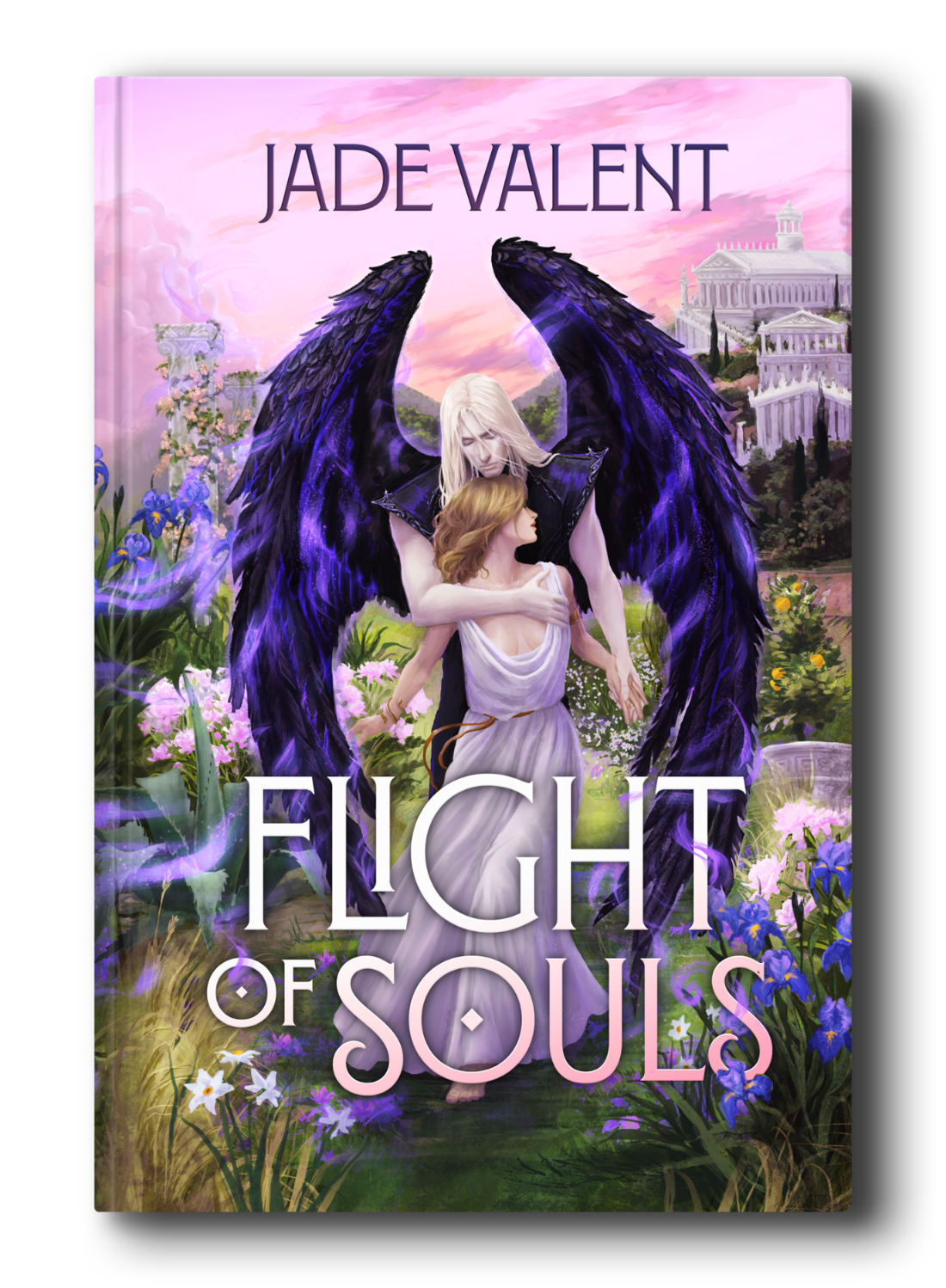
Just look at this result! The art is even better than I had imagined at the outset. It gives me so much joy to see my characters brought to life in a way that’s not only visually stunning, but also makes a cohesive statement about what to expect from their story. It’s easy to picture this in the romance section of a bookstore.
While I’ve spent most of this article talking about the front cover, much effort and detail went into the rest of the design, too. Emmeli and I brainstormed about the visuals for the back cover of the paperback and for the full wrap of the dust jacket. What ended up there is her artistic interpretation of some of my suggestions.
The full cover file shows more artistic cleverness at work, particularly around the transition points between the front, spine, and back. These are areas that can turn out looking wonky if the printer is even a little bit off. Emmeli accounted for that possibility with a more continuous transition. In the dust jacket variant, there is a fade between the cover illustration and the solid colors of the jacket flaps for the same purpose.


With all of the files delivered, it was finally time to order proof copies! This part was especially nerve-wracking, because there are so many little details that have to be nailed down in order for a physical book to look completely professional. If certain things aren’t in sync, such as file formats, dimensions, metadata, or color encoding, the printer might not even accept the files at all! And this was on me as much as it was on Emmeli—I had done all the interior formatting by myself, and I was about to find out whether I’d managed to pull it off.
I uploaded all of my files to both Ingram and KDP, and to my relief, both services accepted everything right away. I was able to get my KDP paperback proof within a few days, while the hardcover from Ingram took about two weeks to arrive. And everything looked fantastic! I was so thrilled that I’d only have to go through that part once. I give credit to Emmeli’s experience in getting all the cover files perfect on the first go.

Final thoughts
Flight of Souls won’t be my only book. I’ve got big plans for these characters and others. But it is my first, and I wanted to make sure I put in the time and resources to give it all the love it deserves. Part of that was saving up for the expense of a custom cover and putting in the hours to search for the right illustrator.
A combination of that diligence and luck in my search led to a great collaboration with Emmeli. She gets a solid recommendation from me.
My biggest takeaway from this experience was that professional cover design requires mastery of more than just illustration or graphics. There are so many elements that go into making something both eye-catching and cohesive. I’ll admit that I stubbornly gave it a try on my own at first, but I’m glad I recognized that I didn’t have the skillset to reach the highest standard in this area. I’ll stick to doing…everything else!